Properties of rhombuses
key notes :
🔷 Definition
A rhombus is a special type of parallelogram where all four sides are equal in length.
👉 It looks like a “tilted square.”
🟩 Properties of a Rhombus
1️⃣ All sides are equal 💎
➡️ AB = BC = CD = DA
2️⃣ Opposite angles are equal 🎯
➡️ ∠A = ∠C and ∠B = ∠D
3️⃣ Diagonals bisect each other at right angles ✖️
➡️ The diagonals intersect at 90∘.
4️⃣ Diagonals bisect the vertex angles 🧭
➡️ Each diagonal cuts the opposite angles into two equal parts.
5️⃣ Opposite sides are parallel 🧮
➡️ AB ∥ CD and AD ∥ BC
6️⃣ Each diagonal divides the rhombus into two congruent triangles 🔺🔺
🧠 Formulas to Remember
📏 Area of a rhombus:
Area = 1 / 2 × d1 × d2
(where d1 and d2 are the diagonals)
📐 Perimeter of a rhombus:
Perimeter = 4 × side
💡 Special Notes
✨ Every square is a rhombus, but not every rhombus is a square.
✨ Rhombus is a type of parallelogram, and also a type of kite.
🎨 Visual Memory Trick
🔸 Think of a rhombus as a diamond-shaped square! 💎
🔹 Equal sides like a square,
🔹 Diagonals like an “X” at 90°.
🌈 Summary Chart
| Property 🧩 | Description 📖 |
|---|---|
| Sides | All four sides are equal |
| Angles | Opposite angles are equal |
| Diagonals | Bisect each other at 90° |
| Parallels | Opposite sides are parallel |
| Symmetry | Two lines of symmetry |
Learn with an example
Quadrilateral QRST is a rhombus. What is ∠PRS?
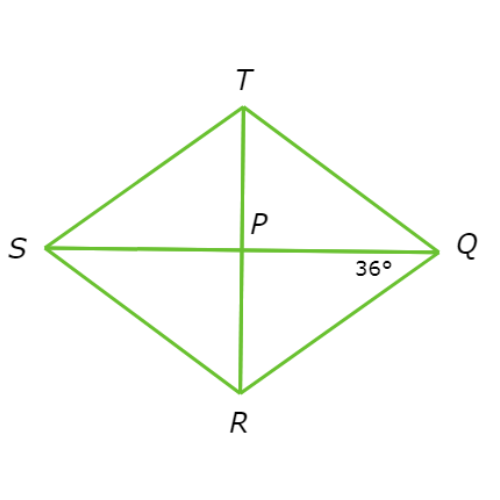
∠PRS = ____°
Since QRST is a rhombus, opposite angles are congruent, QS bisects ∠RQT, and RT bisects ∠QRS.

So, ∠PQR ≅ ∠PQT ≅ ∠PSR ≅ ∠PST and ∠PRQ ≅ ∠PRS ≅ ∠PTQ ≅ ∠PTS. Specifically ∠PQR = ∠PSR = 36°. Also, since QS and RT are perpendicular, ∠RPS = 90° and △PRS is a right triangle.

This means ∠PRS and ∠PSR are complementary. Set the sum of their measures equal to 90° and plug in ∠PSR = 36° to solve for ∠PRS.
∠PRS + ∠PSR = 90°
∠PRS + 36° = 90° Plug in ∠PSR = 36°
∠PRS = 54° Subtract 36° from both sides
So, ∠PRS = 54°.
Quadrilateral GHIJ is a rhombus. What is ∠JIK?
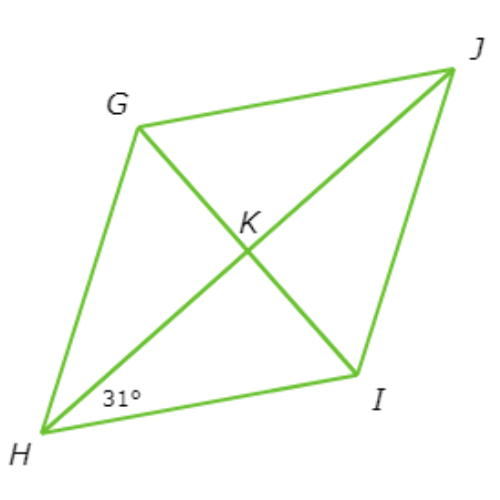
∠JIK = ______°
Since GHIJ is a rhombus, opposite angles are congruent, GI bisects ∠HIJ, and HJ bisects ∠GHI.

So, ∠IHK ≅ ∠GHK ≅ ∠GJK ≅ ∠IJK and ∠HGK ≅ ∠HIK ≅ ∠JGK ≅ ∠JIK. Specifically ∠IHK = ∠IJK = 31°. Also, since GI and HJ are perpendicular, ∠IKJ = 90° and △IJK is a right triangle.

This means ∠IJK and ∠JIK are complementary. Set the sum of their measures equal to 90° and plug in ∠IJK = 31° to solve for ∠JIK.
∠IJK + ∠JIK = 90°
31° + ∠JIK = 90° Plug in ∠IJK = 31°
∠JIK = 59° Subtract 31° from both sides
So, ∠JIK = 59°.
Quadrilateral ABCD is a rhombus. What is ∠ACD?
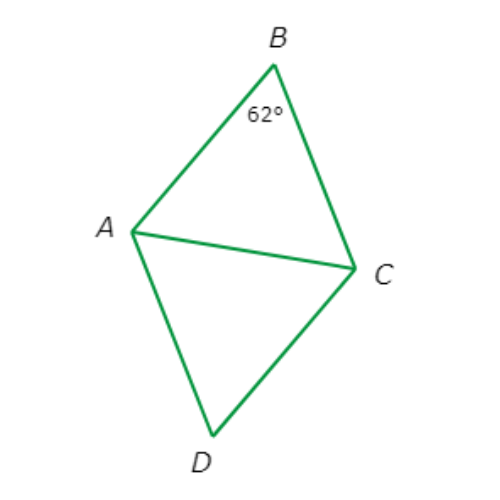
∠ACD= _____°
Since ABCD is a rhombus, ∠BCD and ∠ABC are supplementary.

Set the sum of their measures equal to 180° and plug in ∠ABC to solve for ∠BCD.
∠ABC + ∠BCD = 180°
62° + ∠BCD = 180° Plug in ∠ABC = 62°
∠BCD = 118° Subtract 62° from both sides
Also, AC bisects ∠BCD, so ∠ACD = ∠ACB = 1/2 ∠BCD. Next, plug in ∠BCD = 118° to this equation and solve for ∠ACD.
∠ACD = 1/2 . ∠BCD
= 1/2 (118°) Plug in ∠BCD = 118°
= 59° Multiply
So, ∠ACD=59°.
Let’s practice!